Lesson 15 · Intermediate
Marinas and harbours: architecture and night lights
Read first:
What you will learn
- What to photograph in a marina so it tells people what the place is like.
- How to shoot lights at dusk and night.
- How to keep a night shot steady and clean.
The lesson
A marina is a mix of boats, walls, buildings, signs, lights and water. For a visitor deciding where to go, good shots answer simple questions: what does the entrance look like, what are the berths like, what is nearby? Start wide to show the layout, then take medium shots (a pontoon with boats) and detail shots (a bollard, a sign, a sailor’s hands on a rope). Include some sky and water for a sense of place.
Walls, cranes and clubhouses give straight lines. Keep verticals straight by holding the camera level and not tilting up; if you must tilt, correct it in editing.
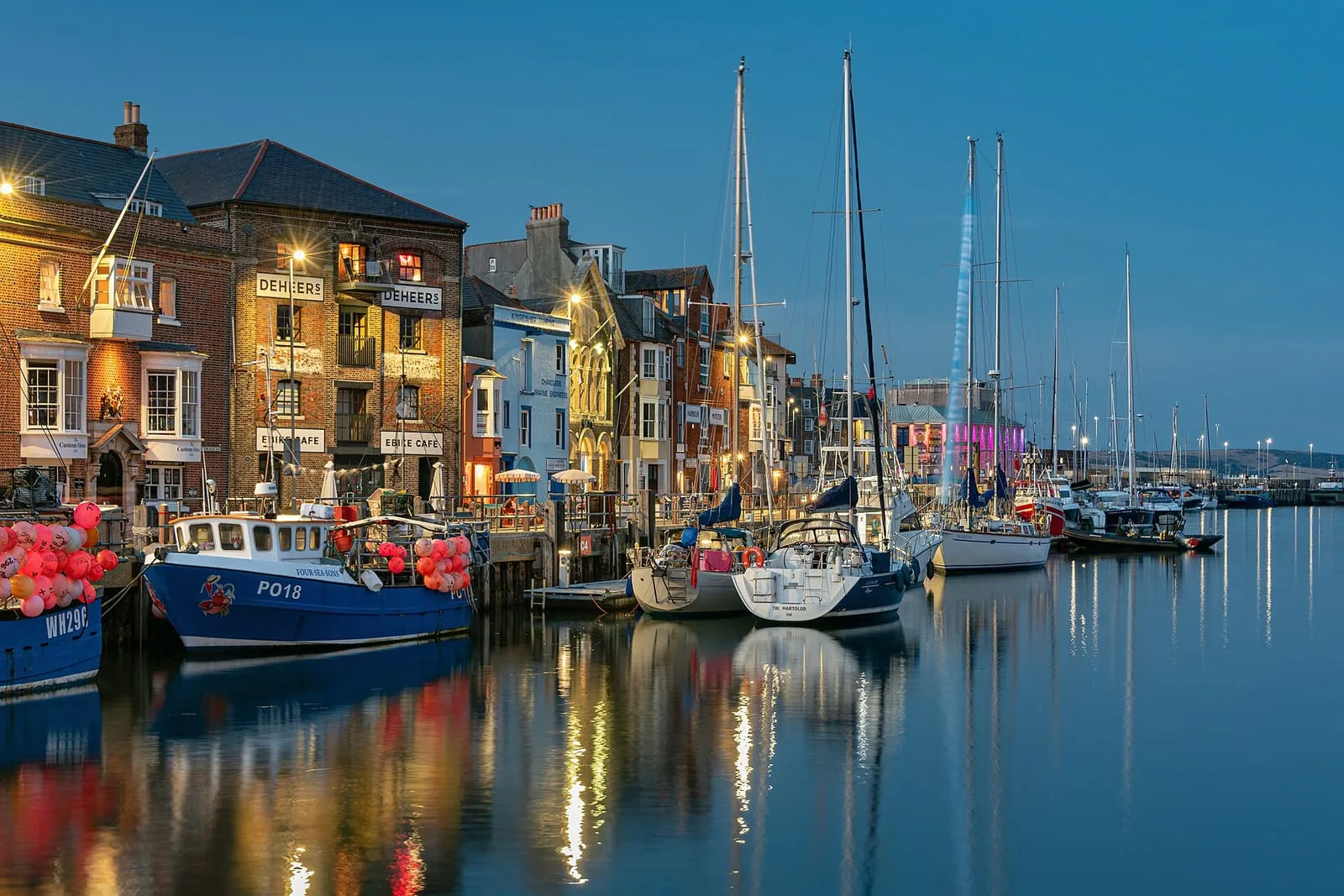
At night or blue hour, lights become the subject. Put the camera on a tripod or rest it on a solid wall, use a low ISO if you can, an aperture around f/5.6 to f/8 and let the shutter stay open for a second or several. Boats and water move, so they blur and the lights draw long reflections on the water, which looks calm and rich. Point lights can become small stars when you narrow the aperture. Use a two-second self-timer so that touching the button does not shake the picture.
Phones have a night mode that does this by combining frames; hold still while it counts down. Still, an unmoving support helps.
Take care with tripods on a pontoon: general craft advice only, keep out of walkways and respect other people.
Practice
- Make a set of five shots of one marina: wide, medium, detail, entrance, sign.
- Take a blue-hour shot at 1 s, 4 s and 15 s (tripod or wall). Compare the water.
- Photograph the same scene with and without the self-timer at a slow shutter.
- Find vertical lines that lean; fix one by keeping the camera level.
- Pick one night photo and describe where the light draws your eye.