Lesson 16 · Intermediate
Seascapes and long exposure
Read first:
What you will learn
- Why a long exposure turns waves into mist.
- What a neutral density (ND) filter does.
- How to set up on a pontoon or shore for a calm, steady shot.
The lesson
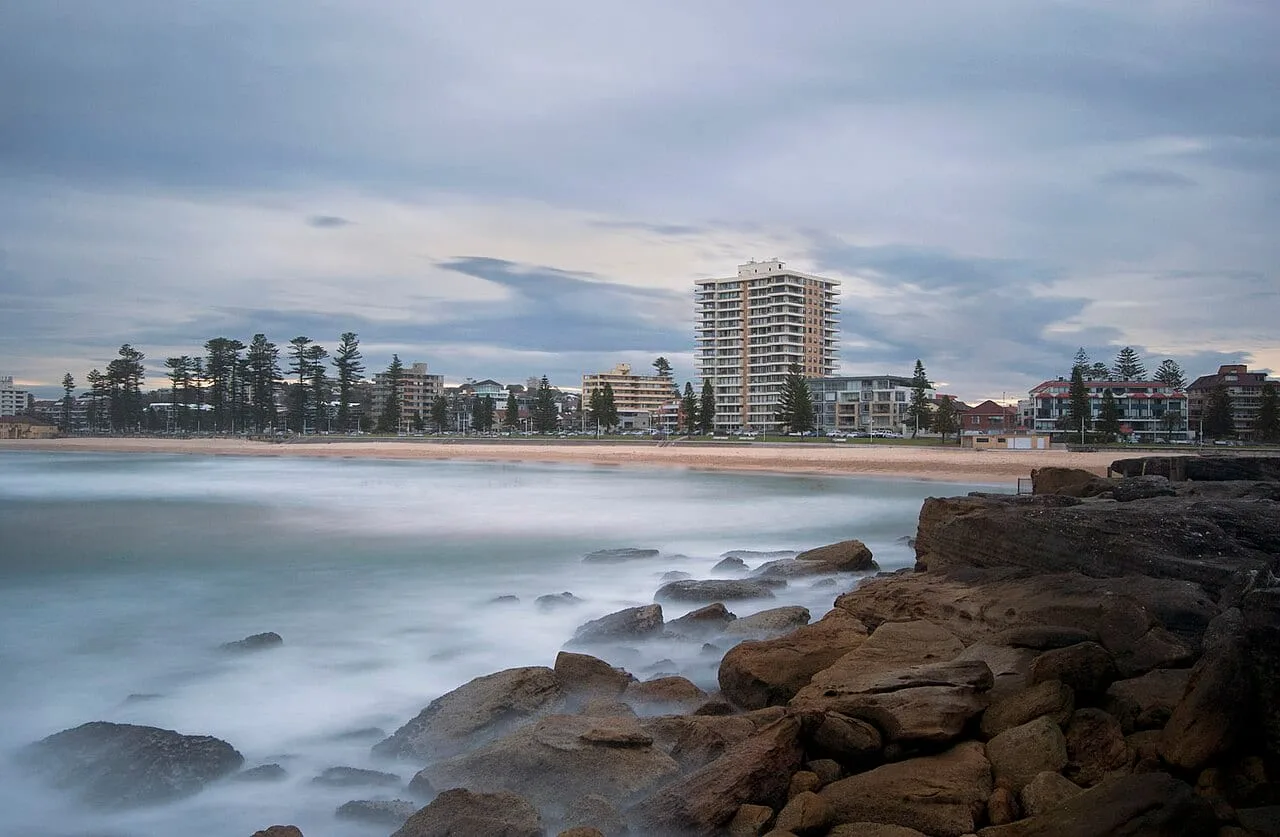
A long exposure holds the shutter open for seconds. Anything that moves smears and anything still stays sharp. Waves become a soft fog around rocks, clouds become streaks and boats at anchor stay clear. Try roughly 1 to 30 seconds as a starting range. About 1 s keeps some texture in waves; several seconds gives a smooth look; long times make the water a plain sheet.
In daylight such a long exposure would overexpose the picture, even at the lowest ISO and narrowest aperture. A neutral density (ND) filter is a dark glass that reduces light evenly without changing the colours. They come in strengths that block a number of stops. A strong ND lets you take a few seconds in full daylight. At dawn or dusk you may not need one.
Setup: a tripod or another very solid support, the self-timer or a remote release, low ISO, a mid aperture around f/8 to f/11, and manual focus so the camera does not search in the dark. With a dense ND filter on, autofocus will not work, so focus before you fit it, then switch to manual. Turn off image stabilisation on a tripod if the manual suggests so. Take a test shot, look at the histogram (lesson 5), adjust.
Craft hints: wind can shake a tripod, so hang a bag from it; check the horizon is level (lesson 9); watch for a wave that wets your gear and keep a cloth ready. Phones can take long exposures through a live photo or a night mode option.
Physics note
Total light on the sensor is intensity times time. An ND filter that cuts it to one-eighth is three stops. Adding stops of ND allows three more stops of shutter time to compensate.
Practice
- Photograph flowing water at 1/250 s, 1 s and 5 s from a steady support.
- If a scene is correct at 1/60 s without a filter, what shutter time does it need with a 3-stop ND?
- Photograph clouds with a long exposure on a breezy day.
- Try to do a long exposure with no tripod by leaning on a wall. How long can you manage?
- List what you would pack for a seascape session.