Lesson 14 · Intermediate
Boats under sail: from shore and from a boat
This lesson teaches photography, not seamanship. The skipper decides what is safe on their boat.
Read first:
What you will learn
- How to photograph sailing boats from the shore and from a boat, with sharp subjects and a level horizon.
- Which shutter speeds and focal lengths suit a moving boat, and why.
- Why the photo always comes second to safety on the water.
Safety first
The photo is never worth the risk. Everyone afloat is responsible for their own safety, and the skipper decides what is safe on their boat. Official sailing bodies advise wearing a lifejacket or buoyancy aid unless you are certain you do not need one, and ask for a proper lookout and a nominated helm. So: do not shoot from another vessel unless its skipper agrees; do not let the camera replace a lookout; never leave the helm or an anchor watch to take a picture; do not lean out, climb or stand on something unstable to get an angle; keep the camera on a strap so both hands are free for the boat; and stop shooting when the skipper asks. If the sea gets rough, put the camera away.
The lesson
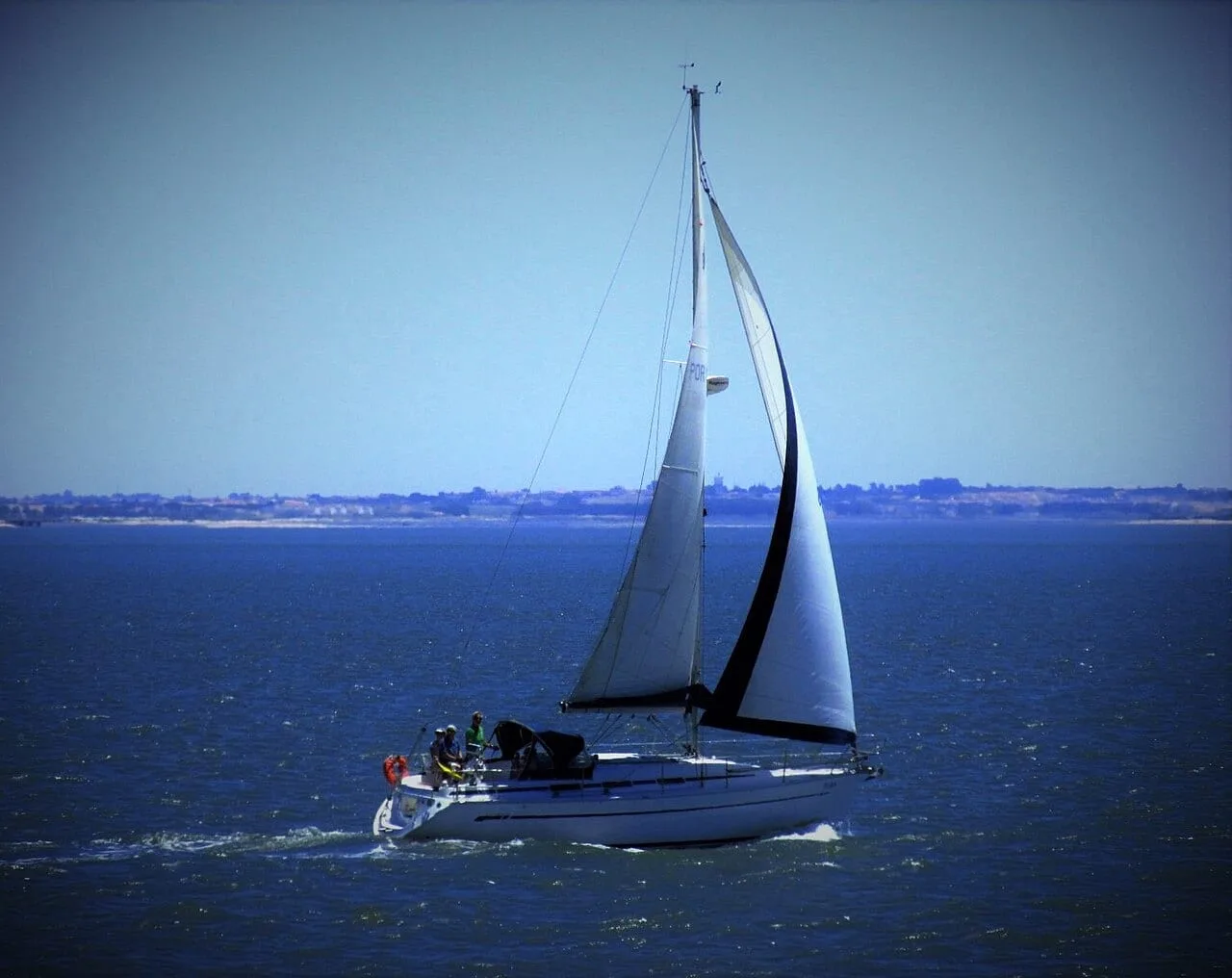
From the shore a sailing boat is a small subject that moves slowly across your frame. Use a longer lens (lesson 7) from a headland, jetty or marina wall, and choose a place where the boat will come to you, such as a mark, a harbour entrance or a point where boats tack. Wait for the boat to be on a clean background: water or sky, not a crowd of other masts.
Shutter speed (lesson 3): a boat moves much less across the frame than a car, so a moderate speed freezes it, but the sea and the sails move too. Spray and breaking waves need a faster speed than a hull. Check the result on the screen and go faster if the sail edges look soft. Keep the horizon level (lesson 9); a tilted horizon makes a boat look as if it is sliding off the sea.
From a boat, you are on a moving platform. Roll and pitch add their own movement to every shot, so use a faster shutter speed than from the shore, support your elbows against your body, and shoot between the movements rather than during a big one. Time your frames to the rhythm of the waves. Sail trim is a good subject: a full sail with the leech edge lit by low sun, the curve of the hull, a crew member hiking out.
Think about what the picture shows: a boat with space to sail into (leave more room in front of the bow than behind the stern), a crew whose faces are not the point, and the weather. If you photograph people, read lesson 18 first.
Physics note
You see two movements added together: the boat across the water and your own platform moving. A camera on a rolling boat moves relative to the scene even when the subject is still, so the shutter speed that is enough on land can blur on a boat. This is the reasoning, not a figure from a source.
Practice
- From the shore, shoot a passing boat at three shutter speeds and note which keeps the sail edge sharp.
- Make the horizon level in the same shot in the camera and again in editing.
- Write three things you would check with a skipper before you take your camera aboard.
- Compose one shot with the boat sailing into open space and one with no space ahead; say which looks better and why.
- List three situations in which you would put the camera away at once.
Sources
Official pages this lesson relies on. Rules differ by place, so check the authority where you are.