Lesson 12 · Beginner
Colour and white balance
What you will learn
- Why the same white object looks different in different light.
- What white balance does and when to override it.
- How to keep a sunset warm.
The lesson
Light has a colour. A candle is orange, midday sun is nearly white, and shade under a clear sky is blue. Your eyes and brain quietly correct for this, so you see a white sail as white in all of them. A camera must be told what to do. White balance is the camera’s setting that makes things that are white in real life look white in the picture.
The colour of light is measured as a temperature in kelvin (K). Lower numbers are warm (orange), higher numbers are cool (blue). Roughly: household bulbs about 2,700 to 3,000 K, daylight between about 5,500 K and 6,500 K, and a clear sky, overcast sky or open shade bluer still. A candle flame is lower than a household bulb. These values are only a guide, and sources differ.
Auto white balance usually does a good job. At sea it can be fooled: a scene filled with one colour, such as blue water and sky, can mislead it, and a sunset may be “corrected” to look dull. Presets such as Daylight, Cloudy, Shade or a manual kelvin value fix this. To keep a sunset glowing, use Daylight rather than Auto.
If you shoot RAW (a file type covered later in the course), white balance can be set freely afterwards. In JPEG, the choice is baked in, so choose carefully.
A grey card or white page shot once in the scene gives a quick reference to set it correctly later.
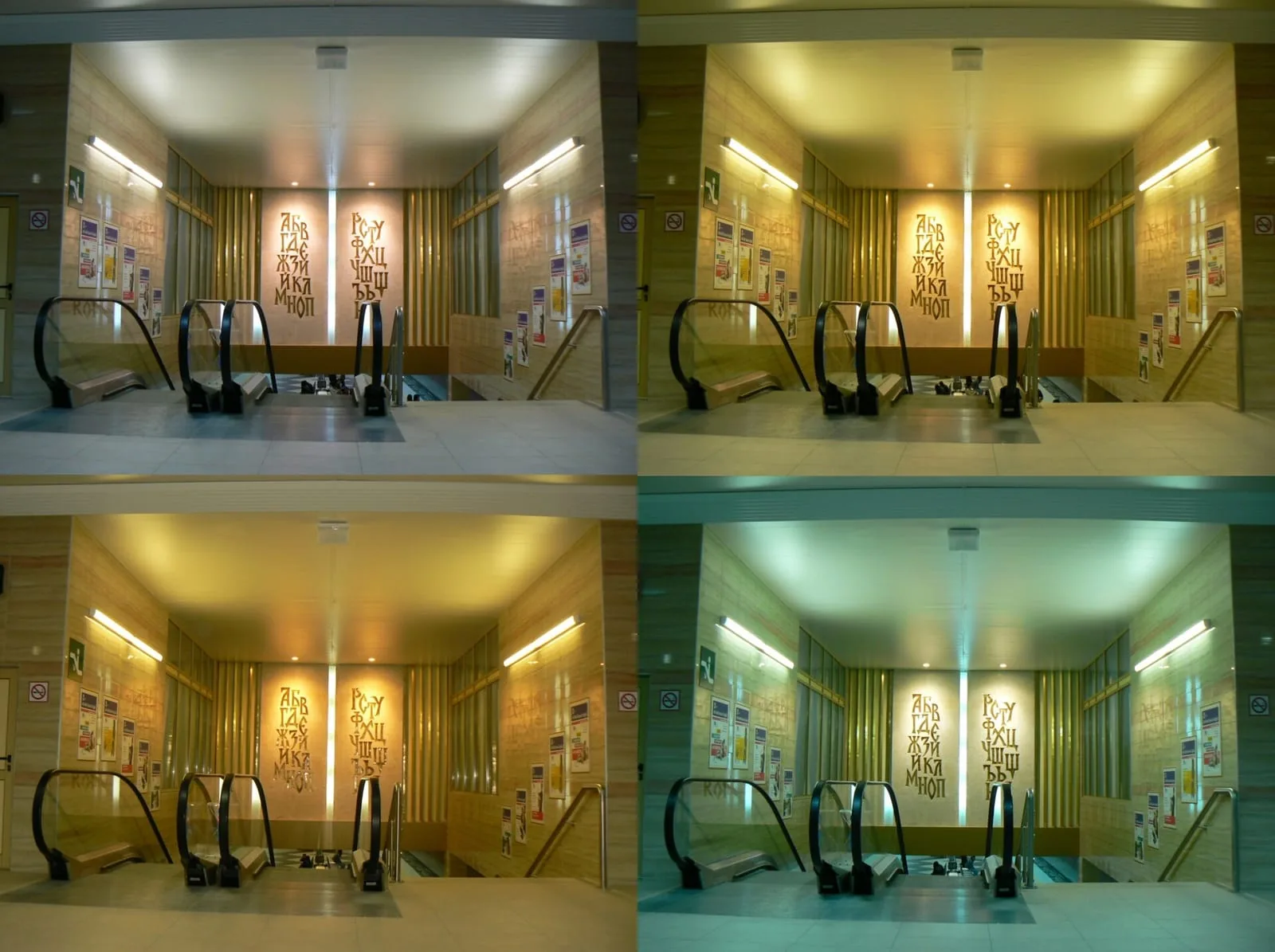
Practice
- Take a white page under a lamp, by a window and outside, on Auto. How does it change?
- Photograph a sunset on Auto and on Daylight. Compare.
- Set the kelvin to 3,000 and to 8,000 for the same scene. What mood does each give?
- Is a warm picture “wrong”? Give an example where a colour cast is the point.
- Describe in one sentence what white balance does.